· Article
I Replaced My Paid Personal CRM with a Git Repo and Two AI Agents
How I turned 829 messy phone contacts into a personal CRM I actually use: one Markdown note per person, a closeness score, a freshness date, and AI agents that log what happens and nudge me every week.
I paid for Dex, a personal CRM. It reminds you to catch up with people, and when something happens in their life (a new job, a move, a baby) you log it, so next time you actually remember.
I logged things maybe once a month. I paid every month. So I cancelled it.
The problem wasn’t the app. It was the friction. I still wanted the result: remember what matters to the people in my life, and get a nudge when I go quiet on someone. So I built my own, and let AI do the boring parts. One day later, 829 messy contacts were 552 clean ones, each with a note, a closeness score and a date for when to reach out next.
The design
Three rules. My phone owns names and numbers. The history is plain text I own. I’m the one who talks to people. The agents remember and suggest; every message goes out from my phone.
Phase 1: Getting the contacts out
The first plan was the Google People API, called from a GitHub Action. While setting it up I found my old OAuth client secret in my notes repo, plus a refresh token pasted into a setup guide. Not my best moment.
I pulled them out and changed the plan. My contacts already sync to Contacts.app on my Mac, and one line of AppleScript exports all of them:
tell application "Contacts" to set vc to vcard of every personA small Python script turns that export into notes. launchd, the scheduler built into macOS, runs it every Monday morning. No API, no OAuth, no tokens.
Pro-Tip: Before you connect an AI agent to anything, look for the version of the integration that needs no credentials. The safest secret is the one that doesn’t exist.
Phase 2: One note per person
---
name: Sam Rivera
closeness: 3
last_contacted: 2026-10-16
next_contact: 2027-01-14
freshness: fresh
---

# Sam Rivera

## About

Friend of [[Lee Alex|Alex]]. Reach out when I'm in Lisbon.

## Timeline

- **2026-10-16**: Coffee in town. Moving to Zurich in January.
Sam is made up. The frontmatter drives the reminders. About is standing context, and names become Obsidian links, so people link to each other. Timeline is what happened, and every dated entry counts as contact.
Phase 3: The triage
829 contacts, and for most of them I had no idea how close we were. I asked Claude for a small page: every contact, buttons from 0 to 6, and an optional box for context.
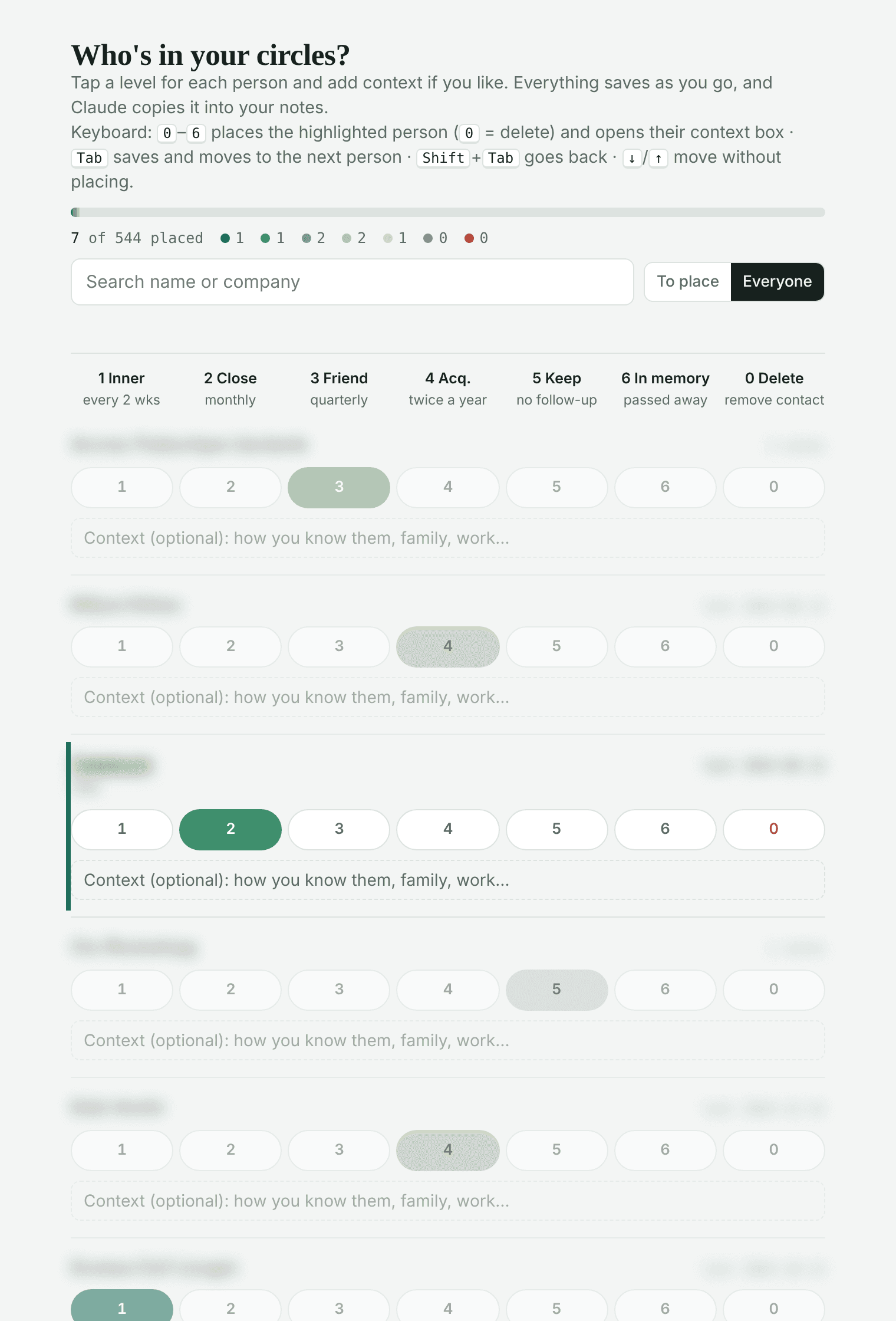
| Level | Meaning | Reach out every |
|---|---|---|
| 1 | Inner circle | 2 weeks |
| 2 | Close friend | month |
| 3 | Friend | 3 months |
| 4 | Acquaintance | 6 months |
| 5 | Keep the number, no follow-up | never |
| 6 | In memory | never |
| 0 | Delete | n/a |
The first version stopped at 5. Then I scrolled past a relative who passed away, and past dozens of people I keep “just in case” but would never text out of nowhere. The scale had to fit real life.
The biggest upgrade was the keyboard. Number pad for the level, the cursor jumps into the context box, Tab to the next person. It started to feel like inbox zero.
My notes were messy: “DELETE”, “merge with the other one”, “husband of …”, “Cousin?”. That’s fine. I’d say “apply my circles” and Claude did the clerical work: delete the zeros (from my phone too, after a backup), merge duplicates keeping every number, turn “husband of” into links both ways, keep my question marks. A guess stays a guess.
Some of what I found: four cards for the same person, two cards that were both me, and a contact whose number was 1-800-MY-APPLE. Final count: 552 contacts, all with a level, and about 180 I actually want to stay in touch with.
Phase 4: Freshness
The script computes last_contacted (newest Timeline entry), next_contact (last contact plus the rhythm for that level) and freshness:
| Freshness | Share of the rhythm passed |
|---|---|
fresh | under 75% |
due-soon | 75–100% |
due | 100–200% |
cold | over 200% |
Cold means more than twice as long as I’d like. That’s who I should text this week.
Pro-Tip: Don’t let the AI do the arithmetic. Put the rules in a script and have the agent run it after every edit. The agent decides what happened; the script decides what it means.
Phase 5: Its own repo
The notes started in my main Obsidian repo, next to my journal. Every agent session cloned all of it to log one coffee. Now contacts have their own private repo, cloned back into the same folder in the vault. Links still work, and the agents see my contacts and nothing else.
One surprise: my vault sits in an iCloud folder. Swapping the folder made iCloud create 474 copies called Something 2.md. All identical. All binned.
Phase 6: The agents
Claude keeps the notes. I type “saw Sam, he got the job”. It finds Sam, adds a dated entry, recomputes the dates and pushes.
The CRM bot does the nudging. Every week it reads the repo, picks who’s due or cold (inner circle first) and pings me with a few names and something worth bringing up.
One AGENTS.md at the root of the repo keeps both of them consistent: the note format, which fields each agent can touch, how to log something, and what to never do, like deleting someone with history without asking me.
These notes are about other people. So the repo is private, there are no credentials anywhere, each agent gets the contacts repo and nothing else, and every message goes out from my phone.
The Takeaway
The AI was the easy part. What made it work:
- A boring, open data model. One Markdown file per person beats any database I’d have to export from later.
- Clear ownership. The phone owns details, I own closeness and context, a script owns the dates.
- Least privilege. A separate repo for a separate job. No secrets to leak.
- Make the human part fast. The number pad did more for this project than any model.
Want to try it? Start smaller than me. One folder, one file per person you care about, and the date you last spoke at the top. The agents can come later.